
Search for “privacy policy vs privacy notice,” and you will find dozens of articles confidently stating that a privacy notice is an internal document for employees, while a privacy policy is the public page on your website. That framing is wrong.
Clear definitions of both documents enhance organizational transparency, but only if you start from what the law actually says.
This guide will help you decide what to call your document, when you might need both a privacy policy and a notice at collection, and how to stay aligned with evolving privacy laws in 2026.
Table of Contents
- Quick Answer: Privacy Policy vs. Privacy Notice in 2026
- Comparison Table: Privacy Policy vs. GDPR Privacy Notice vs. CCPA Notice at Collection
- How Regulators Define a Privacy Notice
- How Businesses Use the Term Privacy Policy
- CCPA and CPRA: Privacy Policy vs. Notice at Collection
- GDPR, UK GDPR and Other Global Privacy Laws on Document Naming
- Internal Privacy Policy vs External Privacy Notice in Practice
- What Your Public-Facing Privacy Document Should Always Cover
- Do You Need Both a Privacy Policy and a Notice at Collection?
- Key Takeaways
- FAQ
- Can I call my GDPR privacy notice a privacy policy on my website?
- Is a privacy statement different from a privacy policy or privacy notice?
- Do small businesses really need an internal privacy policy?
- Can I merge my CCPA Notice at Collection into my main Privacy Policy?
- How often should I update my privacy policy or privacy notice?
Quick Answer: Privacy Policy vs. Privacy Notice in 2026
A privacy notice is an external communication for the public—a transparency document aimed at data subjects that informs individuals about how their personal data is collected, used, and shared.
A “privacy policy” is a generic name that can refer to either the same public document or an internal rulebook for staff, depending on context.
On most websites today, the link in the privacy notice footer labeled “Privacy Policy” or “Privacy Notice” points to the same type of external document explaining what personal data is collected, why, how it is shared, and what rights users have.
Privacy notices are required by multiple data protection laws, and in practice the title rarely matters.
- The only consistent legal naming distinction is in specific regimes: HIPAA requires a “Notice of Privacy Practices,” and California’s CCPA/CPRA mandates a “Notice at Collection” that sits alongside—not instead of—a broader privacy policy.
The table below breaks down exactly where those naming rules diverge across GDPR, CCPA/CPRA, and other major frameworks, so you can see at a glance which document your business actually needs.
Comparison Table: Privacy Policy vs. GDPR Privacy Notice vs. CCPA Notice at Collection
The table below cuts through terminology confusion for founders, data protection officers, and product teams. It compares the three documents you are most likely to encounter across jurisdictions.
| Full Privacy Policy | GDPR/UK GDPR Privacy Notice (Articles 12–14) | CCPA/CPRA Notice at Collection (Cal. Code Regs. Tit. 11 § 7012) | |
|---|---|---|---|
| Purpose | Comprehensive disclosure of an organization’s data handling practices across the full data lifecycle | Transparent information about processing for each data subject | Timely, upfront disclosure at or before the moment data collection occurs |
| When required | Whenever a business collects personal information (required under CCPA; best practice globally) | Whenever personal data is collected directly (Art. 13) or from third parties (Art. 14) | At or before the point of collection—sign-up forms, checkout pages, in-app prompts |
| Typical audience | Website visitors, customers, and any users whose data is processed | Data subjects (customers, app users, and employees—each may get a tailored version) | California consumers whose personal information is being collected |
| Where displayed | Website footer link, app settings, printed materials | Website footer, layered pop-ups, just-in-time banners | Conspicuous link on every page where collection occurs; near form fields or submit buttons |
| Scope of information | All categories of personal data collected, purposes, sharing, sale/sharing disclosures, retention, rights | Controller identity, contact details, DPO, lawful basis, recipients, transfers, retention, rights | Categories of PI collected, purposes, whether sold or shared, retention, and link to full policy |
| Can it be combined? | Can serve as the host document for a Notice at Collection section | Can be titled “Privacy Policy” and still satisfy GDPR requirements | May be embedded as a section of the full Privacy Policy if the link points directly to that section—not just to the top of the page |
A Californian business in 2026 may legally need both a full online privacy policy and a separate or embedded notice at collection, while an EU data controller can focus on a single GDPR-compliant privacy notice that it titles “Privacy Policy” if it prefers.
How Regulators Define a Privacy Notice
The UK ICO’s guidance on transparency makes the regulator’s position clear: a privacy notice is the public-facing document you provide to data subjects so they understand what happens to their data. Compliance with laws like GDPR requires providing a privacy notice, and the GDPR mandates clear privacy notices for data subjects under Articles 12–14.
Under GDPR and UK GDPR, a privacy notice is:
- Public-facing, not internal
- Directed at data subjects—customers, app users, and website visitors—not employees
- Required whenever personal data is collected, whether directly or via third parties
Privacy notices are legally required under various data protection laws. The core content the ICO expects includes your identity and contact details, data protection officer contact if applicable, what personal data you collect, why you collect it, the legal basis for processing, who you share it with, data transfers outside the EEA/UK, retention periods, and data subject rights.
Transparency is a primary focus of privacy notices; they must be concise, intelligible, and written in plain language.
Privacy notices are aimed at customers and data subjects. A common misconception—repeated across competing guides—claims that a privacy notice is an internal document. The ICO directly contradicts that framing. Privacy notices are intended for external users and consumers.
An organization may have multiple notices (one for customers, another for job applicants), but each is outward-facing to its respective data subjects.
How Businesses Use the Term Privacy Policy
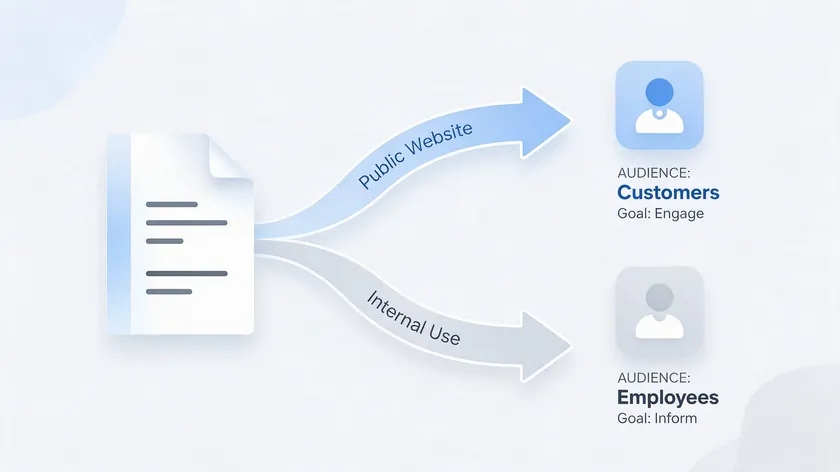
“Privacy policy” is a flexible, non-technical term used in two main ways: as the public-facing document on websites and as an internal governance document that guides employees on how to handle personal data.
The site’s main data privacy policy guide covers the universal clauses every version of this document should include, regardless of which label you choose.
Many organizations—Google, Meta, the BBC, major banks—label their public GDPR-compliant transparency document as “Privacy Policy,” even though regulators would call it a privacy notice.
From a branding and UX perspective, using “Privacy Policy” in the website footer remains the most widely recognized label for the customer-facing document, and no regulator penalizes you for the title choice alone.
The second usage is where the real difference lies. A privacy policy guides internal data handling procedures for employees.
This type of internal document is part of a data protection framework, guiding employees on implementing privacy practices in daily business processes—data mapping, breach response, access controls, and vendor management.
The same organization can legitimately have:
- An external privacy policy or privacy notice for customers and users
- An internal privacy policy for employees and vendors that is not shared publicly
When people debate the difference between a privacy policy and a privacy notice, they are usually comparing these two layers without realizing the external versions are functionally identical.
CCPA and CPRA: Privacy Policy vs. Notice at Collection
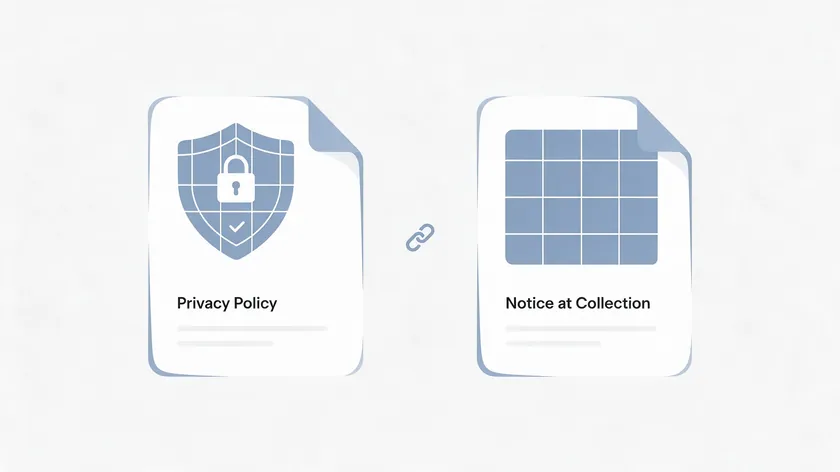
California’s digital privacy laws create the clearest legal separation between these documents. As of 2026, businesses subject to the California Consumer Privacy Act must maintain both a full privacy policy and a notice at collection.
The Full CCPA/CPRA Privacy Policy Requirement
California’s CCPA requires businesses to post a privacy policy that covers all categories of personal information collected, sources, purposes, “sale” and “sharing” disclosures, and consumer rights.
This comprehensive document describes the full lifecycle of collected data and must be updated at least every 12 months.
For clause-by-clause wording of this document, see our California privacy policy template.
The Notice at Collection Requirement
Separately, businesses must provide a Notice at Collection at or before the point where information is collected. Privacy notices must be easily accessible at data collection points.
Under Cal. Code Regs. Tit. 11 § 7012, the notice must list categories of personal data collected (including sensitive information), purposes, whether data is sold or shared, retention periods, and a link to the full Privacy Policy.
The regulations allow combining the Notice at Collection with the Privacy Policy on a single page—but only if the link takes consumers directly to the specific section containing the required disclosures. Simply linking to the top of a generic policy page does not satisfy the requirement.
A practical implementation for a website or mobile app looks like this:
- A general Privacy Policy page linked from the footer
- Contextual Notice at Collection links on sign-up forms, checkout pages, and mobile app install screens, often via an anchor link to a dedicated section of the main policy
Whichever structure you choose, the key requirement stays the same: users must land on the exact disclosures required at that specific collection point, not on the top of a generic privacy policy page.
GDPR, UK GDPR and Other Global Privacy Laws on Document Naming
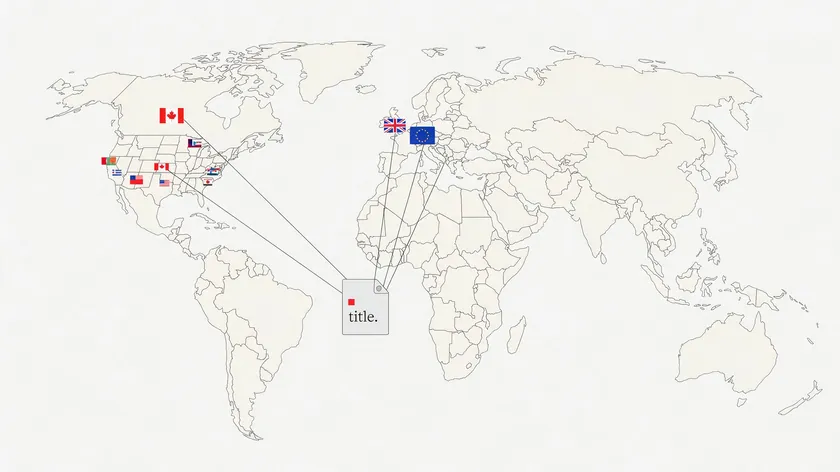
Outside California, most privacy laws focus on what information is provided and how easily accessible it is—not on whether you call the document a privacy policy, privacy notice, or privacy statement. The distinction between privacy policy and privacy notice varies by jurisdiction.
GDPR and UK GDPR
Articles 12–14 require “appropriate measures” for transparent information but do not mandate a specific document title. The EDPB and ICO focus on clarity and layered notices rather than names. Data controllers can title the page however they like, as long as it meets every compliance requirement.
For the eight elements a GDPR notice must contain, see our GDPR compliant privacy policy guide, which includes a checklist you can hold up against your current document.
Other US State Privacy Laws
Virginia, Colorado, Connecticut, and similar states often use “privacy notice” in the statute—the Virginia Consumer Data Protection Act refers to a privacy notice, for instance—but allow businesses to choose titles as long as “privacy” is prominent and all required disclosures appear. These relevant laws share a substance-over-label philosophy.
HIPAA
HIPAA requires a “Notice of Privacy Practices” for covered entities. This is a specialized type of privacy notice with prescribed content, including a mandatory header and specific distribution obligations. HIPAA-covered entities that also handle substance-use disorder records should confirm their Notice of Privacy Practices reflects the latest Part 2 alignment requirements, since these have been an active area of regulatory updates.
PIPEDA (Canada) and Australia’s APPs
Both require publicly available information about personal data practices, commonly called a “Privacy Policy” or “APP Privacy Policy.” Federal laws in both countries emphasize substance and accessibility.
Regulators almost never punish a business for calling its transparency document the “wrong” thing. They act when material disclosures are missing or misleading.
A SaaS platform serving EU, UK, and US users can safely use “Privacy Policy” as the page title while ensuring the contents meet GDPR transparency rules and incorporate required CCPA/CPRA sections.
Internal Privacy Policy vs External Privacy Notice in Practice

Practitioners often use “internal vs. external” language when discussing privacy policies. That framing is useful—as long as you do not confuse it with the inaccurate claim that a “privacy notice” is the internal version.
The Internal Privacy Policy
An internal privacy policy is a governance document for employees and contractors. Privacy policies guide employees on data handling procedures, covering roles and responsibilities, DPIA and ROPA requirements, how to respond to data subject requests, breach reporting workflows, and disciplinary measures for noncompliance.
Privacy policies are primarily intended for internal stakeholders—they are never published on a website or shared with customers.
The External Privacy Notice
The external privacy notice (often titled “Privacy Policy” on websites) is a concise explanation of what information is collected, why, how it is shared, retention periods, and users’ rights.
A privacy notice informs users about data collection practices and must be written in user-friendly language rather than legalese. Privacy notices must be easily accessible on websites—ideally from every page where personal data is collected.
Both documents ensure compliance with data protection laws, but they serve different audiences. The internal policy should never contradict the external notice.
It should operationalize those public commitments—for example, specifying which team archives or deletes certain categories of personal data and on what schedule.
Organizations should review both documents at least annually—every January, for instance—to ensure they still match actual privacy practices and any new privacy regulations coming into force.
What Your Public-Facing Privacy Document Should Always Cover
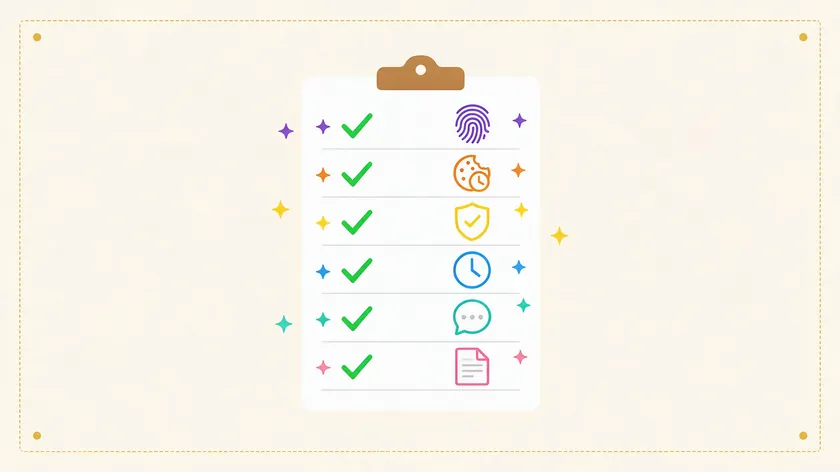
Regardless of whether you call it a privacy policy, privacy notice, or privacy statement, users and regulators expect certain core content. Privacy notices must include contact details and data processing purposes, along with:
- What information is collected—identifiers, contact details, payment data, online identifiers, and any sensitive personal data
- How the information is collected—forms, cookies, SDKs, system logs, and third-party sources such as analytics and advertising partners
- Why the information is collected and the lawful bases, aligned with GDPR, CCPA/CPRA, and other applicable privacy laws
- How the information is used and shared, including any “sale” or “sharing” for marketing purposes or targeted advertising
- How long the information is retained and the criteria used to determine retention periods
- How individuals can exercise their rights—access, deletion, correction, objection, and opt-out of sale/sharing—and who to contact
Privacy notices must be provided when collecting personal data. Dynamic privacy notices update automatically with data processing changes, which is why a managed solution or generator can help keep these disclosures synchronized with real data flows—especially in fast-changing tech stacks.
Do You Need Both a Privacy Policy and a Notice at Collection?
This is the practical question many readers are really asking: “Do I actually need two documents, or can one page do everything?”
Under GDPR and UK GDPR
One well-crafted layered privacy notice—titled “Privacy Policy,” if you prefer—is typically enough for privacy compliance. You might tailor separate versions for employees versus customers, but each is still an outward-facing notice for its respective data subjects.
Under CCPA/CPRA and Other US State Laws
You usually need both a full privacy policy and a notice at collection, even if the latter is technically a section within the same page. Many companies operating globally choose:
- One main privacy policy page covering all regions
- Region-specific layers or banners that serve as Notices at Collection and point to the relevant policy sections
If your business uses cookies, tracking pixels, or mobile SDKs, ensure that consent banners and in-product prompts link directly to the relevant notice or policy section rather than a generic homepage. This gives users more control and helps you maintain compliance across jurisdictions.
Having both documents builds trust with users and stakeholders. Privacy policies are not legally required in every jurisdiction but are recommended for compliance, while privacy notices are legally required under various data protection laws. Together, they form a complete privacy disclosure framework.
Key Takeaways
- Many articles get the privacy policy vs. privacy notice distinction wrong—ICO guidance treats a privacy notice as a public-facing transparency document for data subjects, not an internal document.
- Under GDPR/UK GDPR, you can title your public document “Privacy Policy,” “Privacy Notice,” or “Privacy Statement” as long as it contains the required transparency information and is easily accessible.
- In California, a full privacy policy and a CCPA/CPRA “Notice at Collection” are separate legal requirements, and they can only be combined if the notice links users directly to the exact section containing the mandated disclosures.
- Many organizations also maintain a separate internal privacy policy for staff that is never meant to be seen by customers—a distinct internal document, not to be confused with the external notice.
- Outside California, most data protection laws focus on substance and accessibility rather than document titles, so naming should support user understanding rather than legal jargon.
Now you know when you need a full privacy policy, a notice at collection, or both. Termify’s Privacy Policy Generator helps you build compliant documents with the right disclosures from the start—no guesswork required.
FAQ
Can I call my GDPR privacy notice a privacy policy on my website?
Yes. GDPR does not mandate specific titles, so using “Privacy Policy” for your public privacy notice is acceptable as long as it clearly explains how personal data is collected, used, and shared and what rights users have. Most websites already do this.
Is a privacy statement different from a privacy policy or privacy notice?
“Privacy statement” is generally just another label for the same type of transparency document. What matters is covering all required information under the relevant laws, not the specific word in the title. Pick one name and use it consistently across your websites and apps.
Do small businesses really need an internal privacy policy?
While many data privacy laws focus on external notices, even small teams benefit from a concise internal privacy policy that documents privacy practices, assigns responsibilities, and helps staff handle personal data consistently.
Think of it as guiding employees through day-to-day data handling so your public promises actually match internal reality.
Can I merge my CCPA Notice at Collection into my main Privacy Policy?
California regulations allow combining the Notice at Collection with the Privacy Policy, provided users are taken straight to the specific section containing the required disclosures and the notice is presented at or before the point where information is collected. A link to the top of the page does not comply with the privacy rules.
How often should I update my privacy policy or privacy notice?
Review and update privacy documents whenever data practices change, new tracking tools are implemented, or new privacy laws start applying. At a minimum, audit them once every 12 months.
Companies working with business partners or third parties should also update disclosures when those relationships change to protect both users’ data and organizational credibility.