
An RMA form is the standard document businesses use to authorize, track, and process product returns. This guide covers what a return merchandise authorization form is, what fields it needs, and how to design one for your platform and includes a free copy-paste template you can start using today.
Table of Contents
- Introduction to Return Merchandise Authorization (RMA) Forms
- What Is a Return Merchandise Authorization Form?
- Core Elements of an Effective RMA Form
- What Information Goes on an RMA Form
- Designing a Customer-Friendly RMA Form
- Embedding RMA Forms on Popular Platforms (Shopify, Webflow, etc.)
- How the Return Merchandise Authorization Process Works End-to-End
- Benefits of Using Structured RMA Forms
- Free RMA Form Template
- Common RMA Form Mistakes to Avoid
- Key Takeaways
- FAQs: More About the RMA Form
Introduction to Return Merchandise Authorization (RMA) Forms
Return merchandise authorization is the formal approval process that lets a customer send purchased items back to a vendor or manufacturer for a refund, repair, or replacement. Without this step, returns become chaotic—packages arrive unannounced, warehouses can’t match items to orders, and finance teams lose track of what’s owed.
An RMA form—usually completed online—records all return-critical data in one place. This includes customer information, product identifiers, the reason for the return, and the desired outcome. Think of it as the operational document that makes the broader return merchandise authorization concept actually work day-to-day.
There’s an important distinction here. The business concept of merchandise authorization covers policies, systems, and cross-department accountability.
The return merchandise authorization form is the concrete artifact: the thing a customer fills out, a support agent reviews, and a warehouse worker references when a package arrives.
RMA systems became standard in e-commerce logistics after around 2010, when online order volumes and cross-border returns made informal processes unsustainable.
The rest of this article will show you how to structure RMA forms, assign return merchandise authorization numbers, and connect the process to shipping, inventory, and finance.
What Is a Return Merchandise Authorization Form?

RMA stands for Return Merchandise Authorization. An RMA form is the document—paper or digital—that a customer completes to request authorization to return merchandise to a vendor. It captures everything both parties need to process the return correctly.
The authorization form acts as a kind of agreement. It confirms the conditions under which goods may be returned and what the customer can expect in return, whether that’s a refund, a replacement, or a repair.
Once approved, the form generates or references a return merchandise authorization number that gets printed on shipping labels, included in emails, and scanned in warehouse systems.
RMA forms are usually found on company websites under a returns or support page. They also appear on packing slips, as PDF downloads, and inside customer portals. Regardless of format, they should always capture the same core data.
These forms aren’t limited to consumer e-commerce. B2B environments rely on them just as much—distributors returning defective stock to a manufacturer, dealers submitting warranty swaps with serial numbers, or businesses processing bulk returns across multiple locations.
Core Elements of an Effective RMA Form

Every RMA form, regardless of whether it lives on Shopify, a custom-built website, or a paper template, should share a consistent structure. The goal is to collect enough information to process the return efficiently while keeping the experience simple for the customer.
An RMA form includes customer contact information such as name, email, and address. It requires product details like model and serial number, along with the order number and purchase date. The form should specify the reason for the return—defective, wrong item, wrong size, or simply no longer needed.
Preferred resolution options include a refund or replacement but may also cover store credit or repair under warranty.
Proof of purchase must be attached to the RMA form, and return instructions should be clearly outlined in the form so the customer knows exactly what to do next. The section below breaks each of these element groups down into specific fields and explains why they matter.
What Information Goes on an RMA Form

These are the six field categories every RMA form needs. Each one serves a distinct purpose in keeping the return process organized and defensible.
| Field Category | What to Include | Why It Matters |
|---|---|---|
| RMA Information | RMA number, issue date, expiration date | Tracks the request and prevents duplicate or expired claims |
| Customer Information | Name, order number, email, shipping address | Confirms identity and where the refund or replacement ships |
| Product & Order Details | SKU, product name, quantity, purchase date | Matches the item to inventory and warranty windows |
| Reason for Return | Defective, wrong item, no longer needed, etc. | Feeds return-reason analytics and fraud checks |
| Return Method & Shipping | Carrier, prepaid label yes/no, drop-off vs. pickup | Sets shipping cost ownership expectations |
| Supporting Documentation | Photos, receipt, condition notes | Required for damage claims and fraud prevention |
Include fields for customer contact and product details so every return can be matched to the original order. Allow customers to attach proof of purchase with their request—this is critical for both legitimate claim verification and fraud prevention.
RMA numbers are assigned to track returns throughout the process, tying every label, email, and warehouse action to a single reference point.
Designing a Customer-Friendly RMA Form
Form usability directly affects completion rates. If your RMA form is confusing or slow, customers abandon the process and contact support instead—or worse, they ship items back without authorization.
A clear RMA process improves overall customer satisfaction. But clarity doesn’t happen by accident. It requires deliberate design choices.
Layout and Structure
Use a single-column layout for mobile compatibility. Group related fields logically: customer information first, then product details, then the reason and resolution. For multi-step forms, include progress indicators so the buyer knows how far along they are.
Labels and Helper Text
Write concise, plain-English labels. Instead of “Reference Identifier,” write “Order Number.” Add helper text where confusion is likely—for example, “Find your order number in your order confirmation email.”
Accessibility
Proper contrast ratios, keyboard navigation, and descriptive error messages aren’t optional. Screen reader support ensures all customers can submit a return without barriers.
Inline Policy Reminders
Place policy notes near relevant fields. If there’s a restocking fee for opened items, show it next to the resolution dropdown. If the warranty period has specific cutoffs, note them next to the purchase date field. Provide clear return instructions and policies on the form so nothing catches the buyer off guard after submission.
RMA forms enhance customer experience and build trust when they set honest expectations upfront rather than hiding conditions in fine print.
Embedding RMA Forms on Popular Platforms (Shopify, Webflow, etc.)

Modern RMA forms are almost always embedded directly into e-commerce platforms rather than handled exclusively by email or phone. The exact implementation varies, but the data structure stays the same.
Shopify
Shopify lets merchants configure return rules including return windows, restocking fees, shipping cost allocation, and market-specific policies. You can create a dedicated page for your RMA form using HTML or a form app, then route submissions to email or a return management app like Loop Returns or AfterShip.
Webflow
Webflow users can build an RMA form with native form elements—text inputs, dropdowns, and file uploads—and connect it to a service like Formspree or Zapier. Zapier can then automatically create a row in a spreadsheet, send a confirmation email, or push the data into a returns dashboard.
Other Platforms
WooCommerce and BigCommerce follow similar patterns. Plugins or apps handle the form front-end, while integrations route the data where it needs to go.
| Platform | Form Hosting | Data Routing | Automation Triggers |
|---|---|---|---|
| Shopify | Built-in pages or app | Email, return management apps | Order status updates, label generation |
| Webflow | Native form builder | Formspree, Zapier, webhooks | Email notifications, spreadsheet logging |
| WooCommerce | Plugin-based | Email, ERP system integrations | Status changes, inventory sync |
| BigCommerce | App marketplace | Email, third-party returns software | Refund triggers, CRM updates |
The key takeaway: choose whatever platform fits your business, but make sure it captures the same core fields outlined earlier.
How the Return Merchandise Authorization Process Works End-to-End
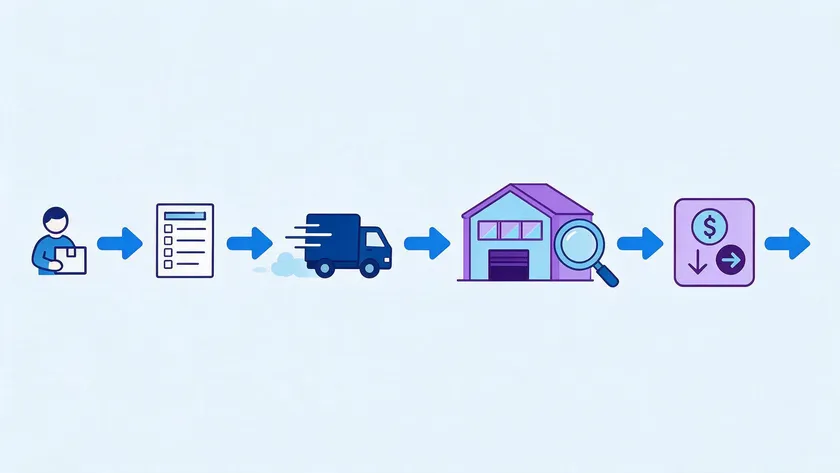
An RMA is not just a form—it’s a multi-stage return process that moves across departments and systems.
Step-by-Step Flow
The process begins when a customer initiates a return request, typically through a self-service portal or by contacting support via email or phone. They fill out the RMA form, providing their order number, the product description, the reason for the return, and their preferred resolution.
The company reviews the request. A support agent—or automated software—checks the information against the return policy. Is the item within the return window? Is the reason eligible? If everything checks out, the request is approved, and a unique RMA number is issued.
The customer then ships the product back, ideally using the original packaging. The RMA number must be visible on the package. Shipping an item without an RMA number may result in rejection at the warehouse.
Most merchants generate a prepaid return label tied to the RMA number so the package can be tracked from drop-off to warehouse receipt.
Once the shipment arrives, warehouse staff scan the tracking number and inspect the item. They verify condition, check that all original accessories and documentation are included, and compare against the form details.
Finally, finance issues the resolution: a refund to the customer’s bank, a replacement shipment, or store credit applied to the account. RMA forms typically require customer information and order details at every stage so nothing falls through the cracks.
Typical Time Frames
Most businesses aim for 1–2 business days for authorization review and 5–7 business days to process a refund after the returned item is received. Communicate these timelines clearly so the customer isn’t left guessing about status.
Benefits of Using Structured RMA Forms

Well-structured RMA forms do more than manage logistics. They reduce costs, protect revenue, and turn returns into a data source you can actually use.
Operational Efficiency
RMA forms streamline return management for high volumes of returns. When every return follows the same format, support teams spend less time chasing missing information. Warehouse staff process items faster because they know exactly what to expect.
Fewer support tickets come in asking “where is my return?” because the customer can track progress with their RMA number.
Financial and Inventory Accuracy
RMA forms help maintain accurate inventory records. Each return triggers a stock adjustment tied to a specific SKU, so your inventory counts stay reliable. Finance teams can reconcile refunds against original invoices without guesswork, and reporting on returns by product, reason, and time period becomes straightforward.
Fraud and Risk Reduction
RMA processes reduce fraud by requiring proof of purchase and condition documentation. Requiring photos for damage claims, enforcing return windows, and mandating that a valid return merchandise authorization number accompanies every shipment all create barriers to abuse. This also strengthens your position in card network chargeback disputes.
Customer-Facing Benefits
A Radial survey from 2025 found that 72% of U.S. consumers prioritize speed and reliability when choosing where to buy—and 24% have stopped purchasing from brands with return friction. A transparent, self-service return process where the buyer can submit a form, obtain a label, and track their return builds the kind of trust that drives repeat purchases.
Automation and Analytics
Automate RMA processing to improve efficiency and customer satisfaction. Set up instant confirmation emails with RMA numbers, automatic return label generation, and status updates as items move through the pipeline.
On the analytics side, track dashboard metrics like RMA volume, approval rate, average processing time, and top return reasons. According to a DHL report, the average online return rate sits around 13%, but the reasons behind those returns vary wildly.
Structured data from RMA forms is what lets you determine whether you have a product quality problem, a description accuracy issue, or a sizing gap.
Free RMA Form Template

Below is a ready-to-copy starting point you can adapt to your own return process.
Return Merchandise Authorization Form
Company Name: _
RMA Number: _
Date Issued: _
Customer Name: _
Email Address: _
Phone: _
Shipping Address: _
Order Number: _
Purchase Date: _
Product Name / SKU: _
Model Number: _
Quantity: _
Reason for Return:
☐ Defective / Faulty ☐ Wrong Item Shipped ☐ Wrong Size / Color ☐ Damaged in Transit ☐ No Longer Needed ☐ Improper Installation ☐ Other: _
Requested Resolution:
☐ Refund ☐ Replacement ☐ Store Credit ☐ Repair
Special Instructions: _
Return Shipping Method:
☐ Prepaid Label (provided) ☐ Customer Arranges Shipping ☐ In-Store Drop-Off
Proof of Purchase Attached? ☐ Yes ☐ No
Condition Notes: Using the original packaging is recommended for returning products. Packaging should include all original accessories and documentation for returns.
Adjust these fields to match your own platform—Shopify, Webflow, or WooCommerce—and align them with your published return policy. You can convert this into an online form, a downloadable PDF, or embed it directly into your website.
Common RMA Form Mistakes to Avoid

Small form design errors create large downstream problems in the return process. Here are the most common ones.
Asking for Unnecessary Data
Every extra field increases the chance the customer abandons the form. If you don’t need their fax number or the name of the person who referred them, don’t ask. Stick to the fields that directly support processing the return.
Hiding Policy Details
If your return window is 30 days, your form should say so—clearly and early. Consumers who discover a restocking fee or condition requirement only after submitting feel misled, and that damages customer satisfaction.
Skipping Reason Code Detail
Defective items typically need specific problem descriptions in RMA requests. A generic “other” checkbox with no follow-up text field makes it nearly impossible to distinguish between quality problems and preference issues. Without granular reason codes, you can’t run meaningful analytics or identify product-level trends that might prevent further returns.
Accepting Returns Without an RMA Number
Allowing returns without a valid return merchandise authorization number overwhelms warehouses and accounting teams.
Unrecognized packages sit in limbo, and matching them to orders after the fact wastes time and money. When a return is refused because it arrived without authorization, it creates friction for both parties—but the alternative is worse.
No Submission Confirmation
If the customer clicks “submit” and sees nothing—no confirmation page, no email, no RMA number—they’ll assume it didn’t work and contact support. Always generate a confirmation automatically with the assigned RMA number and next steps.
Audit your RMA form at least once a year with input from your support and warehouse teams. They see the pain points your analytics dashboard can’t show you.
Key Takeaways
- An RMA form (Return Merchandise Authorization form) is the standardized document that authorizes, tracks, and documents product returns between a customer and a merchant. Every return should be tied to a unique, trackable return merchandise authorization number printed on packaging and emails.
- Well-designed RMA forms speed up the return process, reduce fraud, and improve inventory and financial tracking across e-commerce and retail operations.
- RMA forms must balance two goals: making returns straightforward for honest customers while protecting the business from abuse through required documentation, reason codes, and validation.
- Consistent data capture—reasons for return, product identifiers, and resolution outcomes—turns returns from a pure cost center into a source of product and policy insights that can reduce future return rates.
- RMA forms, policies, and automation should be reviewed at least annually to stay aligned with law, customer expectations, and platform features.
Your RMA process handles the request—but it doesn’t cover the legal terms behind it. Try the Return and Refund Policy Generator →
FAQs: More About the RMA Form
These questions address practical issues and edge cases in the return process that business owners frequently encounter but that aren’t always covered in standard guides.
Can I process a return without an RMA form or RMA number?
Some small merchants and stores still accept informal returns—a customer sends an email, and the merchant says, “Go ahead and mail it back.” This works until it doesn’t. Without a formal document, you have no standardized record of what was agreed, no way to track the shipment status efficiently, and no defense if a dispute arises.
Even if you’re not ready for a full digital form, always issue at least a simple return merchandise authorization number and collect minimal information: who the customer is, what they’re returning, and why. That baseline protects both the buyer and the merchant from confusion later.
How long should I keep RMA and customer information records?
Retention depends on jurisdiction and industry. Most businesses keep RMA records for 2–7 years to align with tax filing requirements, accounting audit periods, and warranty period obligations. In some industries (medical devices, automotive parts), regulatory requirements may push retention even longer.
Consult legal counsel on exact durations for your situation. Store data securely—encrypted at rest, access-controlled—and delete it once it’s no longer needed. Regulations like GDPR and CCPA impose specific rules on how long you can hold customer data and under what conditions.
What if a customer ships back items after the RMA expiry date?
RMA numbers often have an expiration date of 7 to 30 days. If a package arrives after the expiry, standard approaches include refusing the shipment and returning it to the sender or processing it under adjusted terms—for example, store credit only instead of a full refund or applying a restocking fee.
Your RMA form and published policy should clearly state expiry rules. Staff must apply them consistently but allow case-by-case exceptions for situations where the customer permanently relinquishes ownership of a defective item or where a delayed shipment was caused by carrier issues outside the customer’s control.
How should I handle international RMA forms and returns?
International returns add complexity that domestic returns don’t have: customs documentation, return addresses in different countries, higher shipping costs, and longer transit timelines.
Under the EU Consumer Rights Directive, consumers in the EU have a mandatory 14-day cooling-off period for online order purchases, and sellers must provide a standard withdrawal form.
Add country-specific fields to your RMA form, clarify who pays duties and return shipping, and consider using regional warehouses or return consolidation partners. If you sell to an international address, make sure your form accounts for that—a single domestic-only RMA process will create friction and transaction errors for cross-border customers.
Can RMA data help reduce future returns?
Structured RMA data is one of the best tools for understanding why consumers send products back at scale. When every return includes a reason code, product identifier, and resolution outcome, you can analyze trends that would otherwise stay hidden.
For example, if a specific SKU shows a spike in “wrong size” returns, that’s a signal to update your size charts or add a sizing tool to the product page. If “damaged in transit” clusters around a certain carrier or region, your packaging or shipping partner may need attention.
One apparel brand reportedly cut return rates from 28% to 16% after using RMA data to overhaul product descriptions and sizing guides. The data is only as useful as the form that collects it—which is why every field on your RMA form should be there for a reason.